
Escalation Paths That Work When Tier One Is Asleep
A page is a bet. The monitoring sends an alert to the on-call phone at 3 AM. You are betting that the phone is charged and that it is not on silent. You are betting that the person hears it through a closed door and a deep sleep. And you are betting that they are in any state to respond. Most nights you win. Some nights the phone died at eleven, or the ringer was muted in a cinema and never unmuted. Or the on-call person is on a motorway with nowhere safe to stop. I have been on both ends of that bet. If your plan for those nights is "surely they'll answer," your plan is hope.
An escalation path is the plan for losing the bet. It is a written chain of who gets contacted next, triggered by what, after how long. It ends, if it must, with someone outside the company entirely. The property that matters is that it was designed in daylight, argued over calmly, and written down before the night it runs. A path improvised at 3:40 AM by a colleague scrolling a stale contact list is not a path. It is a scavenger hunt.
This guide builds the path for a small team. It covers the rungs and the timers that drive them, and the external rungs nobody wires up until they need them. It covers the manual fallback for tooling that can only send an alert. It also covers the culture that makes people climb the ladder instead of sitting on the fire. Finally, it covers the quarterly drill that proves the numbers still ring.
In this guide
- The anatomy of an escalation chain
- Timers: the engine of escalation
- Designing the rungs honestly at small scale
- The external rungs everyone forgets
- Automated and manual escalation mechanics
- The no-shame architecture
- Testing the path: the quarterly drill
- The escalation policy one-pager
- Where to go next
The anatomy of an escalation chain
Two words first, because the whole design hangs on them. A page is an alert delivered in a way meant to interrupt a human immediately — a phone alarm, not an email. An acknowledgment (universally shortened to ack) is the responder's signal back to the system, or to the team. It says "I have seen this and I am on it." An ack is not a fix and promises no fix — it answers exactly one question: is a human engaged, yes or no? Escalation is what happens while the answer is no.
The chain itself is a ladder of rungs, each one a person or group plus the condition that activates them. For a small team it almost always looks like this:
- Rung 1 — the primary: the scheduled on-call person. Activated by the alert itself.
- Rung 2 — the backup: the second scheduled name (or simply the next teammate in a fixed order). Activated when the primary has not acked in time.
- Rung 3 — the wider net: the manager, or the remaining teammate(s). Activated when neither scheduled person has acked, or when the responder asks for help.
- Rung 4 — external help: the managed service provider's emergency line, a vendor's support desk, the ISP's operations center. Activated when the problem is beyond the team, or the team is beyond reach.
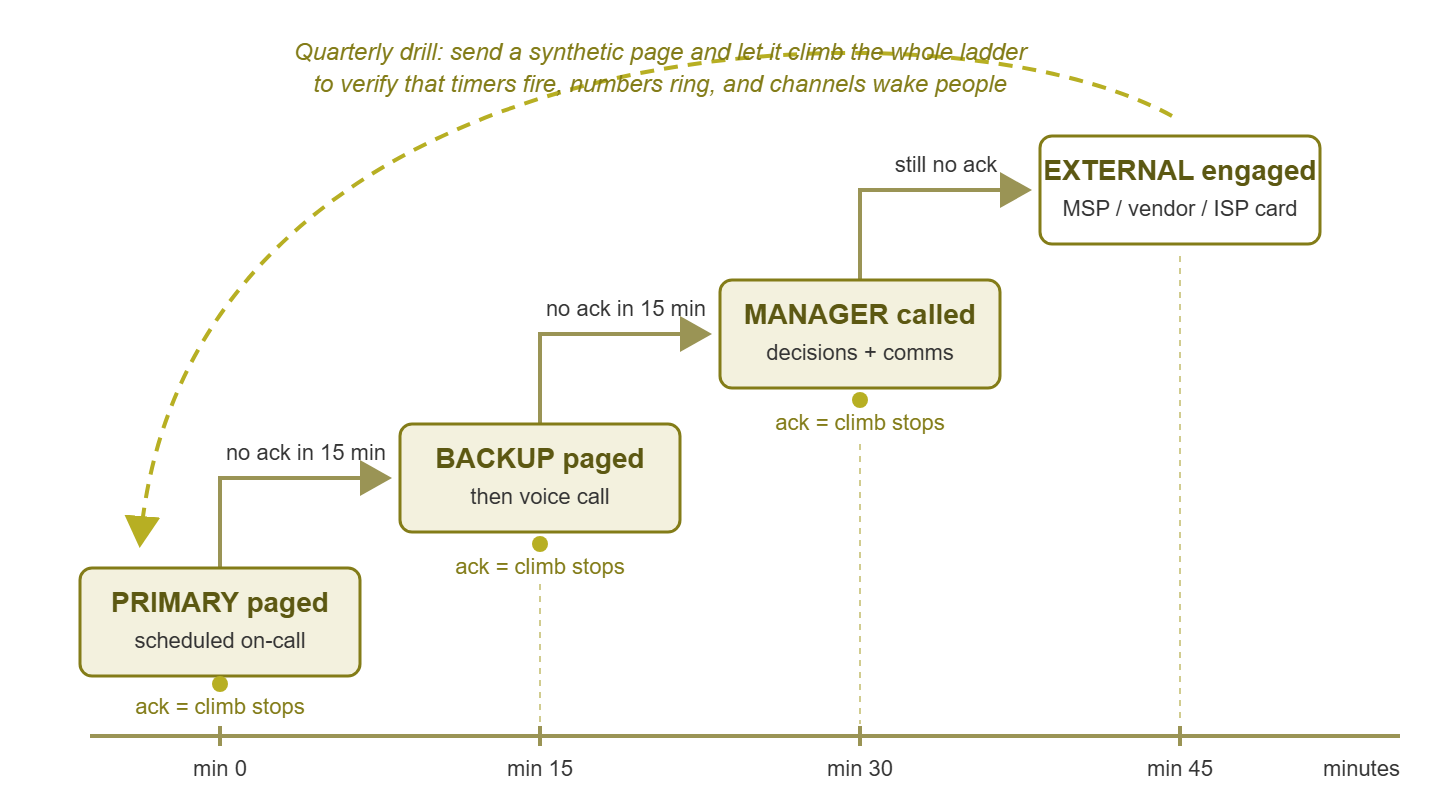
Figure 1: The escalation ladder. Time drives the climb; an ack at any rung stops it; the quarterly drill walks the whole ladder on purpose.
Notice what the ladder is not: it is not a hierarchy of skill or blame. It is a search pattern for an engaged human, widening on a timer until it finds one.
Timers: the engine of escalation
Rungs without timers are decoration. The engine of the whole design is a simple rule applied at every level: unacked after N minutes means the next rung fires automatically. There is no judgment call, no "let's give them a bit longer," and no one deciding at 3 AM whether it would be rude to wake the backup. The timer decides, because the timer was agreed in daylight and has never once been talked out of anything.
Size N by asking what this class of outage costs per minute and how long the fix needs once someone is engaged. For a genuinely critical page, think about the worst case you are accepting. For example, the site is down, the internet link is dead, or payroll's server is off. With a 15-minute rung timer, a second human is not even tried for 15 minutes. With three internal rungs it can be 45 minutes before you reach outside help. Stretch each rung to an hour and the same arithmetic lets a critical outage run for three hours on nothing but hope. That is why critical pages escalate in minutes: 10–15 minutes per rung is the small-team norm. That is long enough for a human to wake, find the phone, and ack. It is short enough that finding a responder never becomes the outage's longest phase. Urgent-but-not-critical alerts can take 30 minutes per rung. Anything that can wait for morning should not be paging at night at all. That tiering discipline is its own subject (see Alert Fatigue).
There is a second, subtler timer worth wiring: ack-then-stall escalation. The primary acks at 3:05 and then — nothing. No update, no resolution, for 45 minutes. Maybe they fell back asleep mid-investigation, maybe they are in deeper water than they will admit, maybe their connection died. An ack silences the ladder, so a stalled responder is invisible unless you plan for it. Here is the rule that works. An acked critical incident with no progress signal for 30–45 minutes triggers a check-in call from the backup. Always frame it as "what can I take off your plate?" and never as "why isn't this fixed?" It is a safety net for the responder, not a leash.
Tip: do not size timers so tight that ordinary life trips them. A primary in the shower, or driving ten minutes home, will miss a 5-minute window and trigger a needless full-ladder wake-up. That teaches everyone to resent the system. Ten minutes is a floor, not a target to beat.
Designing the rungs honestly at small scale
Big-company escalation charts assume a tier-two team, an incident commander pool, and a follow-the-sun NOC. You have four people and a manager who last touched a server some years ago. Design for that honestly. A chart written for a hundred engineers does not shrink to fit four; it just has more empty boxes.
When the team is two or three people, "the backup" is simply the whole rest of the team. That is fine, but write the order down anyway. "Everyone else" is not a rung; "Sam, then Dana" is. The point of the ladder is that at every moment exactly one next action is defined. Ambiguity about who gets the 3:15 call recreates the diffusion of responsibility the on-call rotation was built to kill (see Setting Up Your First On-Call Rotation).
The manager rung needs special honesty. If your manager cannot fix a database, putting them on the ladder feels pointless, until you name what the rung is for. The manager's 4 AM job is decisions and communications, not repairs. That means authorizing the emergency spend and approving the scary reboot of the system half the company uses. It means deciding whether the outage is bad enough to tell the executive team or customers. It also means taking the "keep stakeholders updated" burden off the person with their hands in the wreckage. That split, one person fixes and another coordinates, is the core of incident command. It matters even at five people. The Incident Response guide covers it properly. Put the manager on the ladder for that job, say so in the policy, and the rung stops being awkward.
The external rungs everyone forgets
The rungs beyond the company are the ones nobody wires up, because on a calm Tuesday they feel unnecessary. Then a core switch dies at 2 AM and someone is creating a support account on a vendor's portal, from a phone. They discover the contract does not cover overnight response anyway. Three external rungs deserve pre-wiring:
- The MSP's emergency line. If a managed service provider covers any part of your stack, their after-hours number, your customer ID, and what they will actually do at night belong on the card. Agree these details with them, rather than assuming.
- Vendor support contracts. Hardware and software support entitlements must be checked before 3 AM. Check which systems have active contracts, what severity levels exist and what response each promises. Check whether coverage is business-hours or round-the-clock. Check which contract or serial numbers the support desk will demand before speaking to you. Discovering at 3 AM that the dead firewall's support lapsed — or that "24x7" applies only to the one product you did not buy it for — is a classic.
- The ISP's NOC. The network operations center is the ISP's own monitoring-and-repair desk — the number that reaches an engineer rather than a sales queue. Record it, plus your circuit IDs, because "which circuit?" is their first question and the answer lives on an invoice nobody can find at night.
All of this condenses into the external-escalation card, one small table kept with the on-call kit:
| Who | Number / channel | Have ready | Coverage | They will do |
|---|---|---|---|---|
| MSP emergency | Phone (24x7 line) | Customer ID | Round-the-clock | Remote triage of servers they manage |
| Firewall vendor | Support hotline | Contract ID, serial | 24x7, sev-1 only | Hardware replacement, config help |
| ISP NOC | Phone | Circuit IDs, site address | Round-the-clock | Line tests, dispatch |
| Line-of-business app vendor | Support portal + phone | Customer number | Business hours | Log a sev-1 for morning |
Automated and manual escalation mechanics
Where your alerting or notification layer supports it, automate the ladder. The tool holds the schedule, fires the page, starts the timer, and walks the chain on its own. It goes from primary, to backup, to the wider net. It switches channels as it climbs (app push, then SMS, then an actual phone call). Automation is worth having because the machine does not feel awkward at 3 AM. It never hesitates to wake the second person, never decides to give the primary "five more minutes," never misdials. What these escalation features look like across channels and tools is covered in Notification Channels. That guide also covers how to pick channels that reliably wake humans.
But plenty of small teams run on tooling that can send an alert and nothing more. The ladder still works — it just runs on humans and a card. The manual fallback is the phone-tree card: a short, explicit instruction sheet that anyone awake can execute. The wording matters; vague cards fail. Compare "escalate if no response" with:
CRITICAL page, no ack after 15 min:
  CALL the backup's PHONE. Voice call. Not chat, not email.
Backup does not pick up after 2 tries in 10 min:
  CALL the manager's phone.
Manager unreachable after 10 min:
  Use the external card. MSP first if it is a server;
  ISP NOC if it is the internet link.
Whoever acks POSTS one line in the incident channel:
  "I have it" + timestamp.
Note what the card insists on: voice calls. Chat messages and emails are polite, silent, and ignorable — exactly wrong for escalation. A phone call is the one channel that rings loudly by default and that most phones will let favorite contacts push through do-not-disturb. It demands a binary, immediate answer: picked up or not, engaged or climb again. Nothing fancier has replaced it as the escalation channel of last resort. That is why on-call phones are set so teammates' numbers always ring through. That two-minute settings change belongs on the rotation's launch checklist.
The no-shame architecture
Everything above is plumbing, and plumbing is the easy half. The hard half is cultural: on many teams, escalating feels like failing. Waking the backup means admitting you could not handle it; calling the manager means broadcasting it. So responders sit alone on a worsening outage for two hours, trying one more thing, protecting everyone's sleep except their own. The business eats the cost of their politeness. You must design that shame out, explicitly.
Say it in the policy, in writing: escalation is designed behavior, not failure. The ladder exists to be climbed. Escalating early is correct and will be praised; the only genuine on-call failure is silence — sitting on a growing fire without telling anyone. Two supporting rules make it real. The two-person rule means any scary, production-destructive action gets a second voice on the line first whenever one is reachable. Examples include deleting data to free a full disk, failing over a database, and powering off shared storage. This is not because the responder is untrusted but because 4 AM judgment plus irreversibility is a bad combination for anyone. And the review rule: every escalation, real or triggered by a missed timer, gets looked at afterwards for path health only. Did the timers fit? Did the numbers work? Was the right rung reached? It is never a hearing about who failed to answer. The moment someone gets grilled for sleeping through a page, everyone quietly starts muting less and resenting more, and your ladder rusts. Blameless review technique is covered in Post-Incident Reviews.
Testing the path: the quarterly drill
An escalation path is a fire escape: it exists for a night you hope never comes, and it decays invisibly while you are not using it. Phone numbers go stale when people change carriers. The vendor contract quietly lapses at renewal. The backup's new phone has do-not-disturb configured fresh, with no exceptions. None of this announces itself — you find out at 3 AM, or you find out in a drill. Choose the drill.
At Meridian Parts the escalation policy was a laminated sheet on the server-room door with three names on it. The second name had left the company fourteen months earlier. His mobile number now belonged to a stranger who did not enjoy the call at ten past three. The third name was the previous IT manager; her successor had never been told she was on a ladder. The primary, having failed to reach anyone who still worked there, fixed the switch stack alone at half past four and wrote it up in the morning. The review recorded that the escalation path had been "not fully current." The sheet is now a card that is read aloud at every quarterly drill, and the drill has caught a stale number twice since.
Once a quarter, run the ladder for real, announced in advance so nobody panics but unrehearsed in its details:
- Fire a clearly labeled synthetic test page at the primary — who has been told, this once, to deliberately ignore it.
- Watch the timers: does the backup actually get paged at the agreed minute, on the agreed channel? Does the manager's phone actually ring next?
- Walk one branch of the external card without crying wolf. Call the ISP NOC's number and confirm it reaches a human who accepts your circuit ID. Confirm the vendor contract numbers against the support portal while it is daylight.
- Time the whole climb end to end, and note every snag. Note the number that rang a departed employee, the push notification that arrived silently, and the timer that never fired.
Every finding goes into the card and the policy the same day. A drill whose findings stay in someone's head has only proven the path is broken, not fixed it. The first drill almost always finds something; that is not embarrassing, it is the drill doing its job. The stale number discovered on a Tuesday at 2 PM costs a chuckle. The same number discovered during a real outage costs an hour of downtime and a very bad story.
The escalation policy one-pager
The whole design fits on one page, and it should live where the on-call kit lives — linked from the alerts themselves if your tooling allows. Two tables carry it. The ladder:
| Rung | Who | Trigger | Channel | Their job |
|---|---|---|---|---|
| 1 | Primary on-call | Critical alert fires | Page (app/SMS/call) | Ack, then fix or climb |
| 2 | Backup on-call | No ack after 15 min, or primary requests help | Page, then voice call | Take over or assist |
| 3 | Manager | No ack from 1–2 after 30 min, or decision needed | Voice call | Decisions, communications |
| 4 | External (per card) | Beyond the team, or team unreachable after 45 min | Phone, contract in hand | Vendor/ISP/MSP action |
...plus the external-escalation card from earlier, kept current by the quarterly drill. Add three lines of prose to the page: the ack-then-stall rule, the two-person rule, and the no-shame rule. That is the entire policy — short enough that people actually know it, which is the only kind of policy that works at night.
Where to go next
A page is still a bet. The ladder is what you hold when you lose it: rungs, timers, voice calls, an external card, and a drill that keeps the numbers true. The path leans on its neighbors. A rotation defines who rung one even is (Setting Up Your First On-Call Rotation). Handoffs keep the kit and the card in the incoming person's hands (The On-Call Handoff). Written expectations make a missed timer a systems question instead of a disciplinary one (On-Call Policy). The best escalation path is one that rarely runs, because the pages behind it are few and real. That is the work of Humane On-Call and the rest of Escalation & On-Call for Small Teams. Build the ladder in daylight. The night does not wait for you to finish it.
Put this into practice with SysPeep Monitor
An escalation ladder only stays credible if the pages that start it are worth answering. SysPeep Monitor collects health and performance data over SNMP, WMI, and SSH. Its thresholds, dependencies, and alert rules are built to keep false pages off your ladder in the first place. It provides email and other notifications to reach whoever is on point. Download the free trial and see what a quieter rung one feels like.
Download Free TrialLearn About SysPeep - All Rights Reserved.